

Working principle:
The eddy current sensor can measure the distance between the measured metal conductor and the probe surface statically and dynamically non-contact, high linearity, and high resolution. It is a non-contact linear measurement tool. The eddy current sensor can accurately measure the static and dynamic relative displacement changes between the measured body (must be a metal conductor) and the end face of the probe. In high-speed rotating machinery and reciprocating motion machinery state analysis, vibration research, analysis and measurement, it can continuously and accurately collect various parameters of the rotor vibration state for non-contact high-precision vibration and displacement signals. Such as shaft radial vibration, amplitude and axial position. Eddy current sensors are widely used in online monitoring and fault diagnosis of large rotating machinery due to their long-term reliability, wide measurement range, high sensitivity, and high resolution.

From the theoretical analysis of rotor dynamics and bearing science, the state of motion of large rotating machinery mainly depends on its core-the shaft. The eddy current sensor can directly non-contact measure the state of the rotating shaft, and can provide critical information for early determination of mechanical problems such as rotor imbalance, misalignment, bearing wear, shaft cracks, and friction.
According to the principle of Faraday's electromagnetic induction, when a block-shaped metal conductor is placed in a changing magnetic field or cuts magnetic lines of force in a magnetic field, a vortex-shaped induced current will be generated in the conductor, which is called an eddy current. The above phenomenon is called the eddy current effect. The sensor made according to the eddy current effect is called the eddy current sensor.

The high-frequency oscillating current in the proximitor flows into the probe coil through the extension cable, and an alternating magnetic field is generated in the coil of the probe head. When the measured metal body approaches this magnetic field, an induced current is generated on the metal surface. At the same time, the eddy current field also generates an alternating magnetic field in the opposite direction to the head coil. Due to its reaction, the amplitude and phase of the high-frequency current of the head coil are changed (the effective impedance of the coil). This change is related to parameters such as metal permeability, electrical conductivity, coil geometry, geometric dimensions, current frequency, and the distance from the head coil to the surface of the metal conductor. Generally, it is assumed that the material of the metal conductor is uniform and the performance is linear and isotropic. The physical properties of the coil and the metal conductor system can be determined by the electrical conductivity б, the magnetic permeability ξ, the size factor τ, the head body coil the surface of the metal conductor distance D, the current intensity I and the frequency ω parameters to describe. The characteristic impedance of the coil can be expressed by the function Z=F(τ, ξ, б, D, I, ω). Usually we can control the parameters τ, ξ, б, I, ω to be constant within a certain range, then the characteristic impedance Z of the coil becomes a single-valued function of the distance D. Although its entire function is non-linear and its function characteristic is an "S"-shaped curve, it can be selected to be approximately linear. Through the processing of the electronic circuit of the proximitor, the change of the coil impedance Z, that is, the change of the distance D between the head body coil and the metal conductor, is converted into the change of voltage or current. The size of the output signal changes with the distance between the probe and the surface of the measured object. The eddy current sensor is based on this principle to realize the measurement of the displacement, vibration and other parameters of the metal object.
Work process:
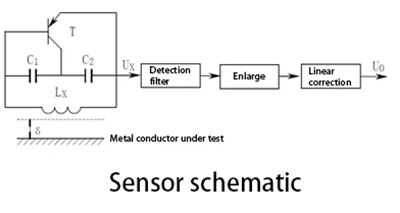
When the distance between the measured metal and the probe changes, the Q value of the coil in the probe also changes, and the change in Q value causes a change in the amplitude of the oscillation voltage. The oscillating voltage that changes with distance is transformed into voltage (current) changes through detection, filtering, linear compensation, and normalization processing, and finally the mechanical displacement (gap) is converted into voltage (current). From the above, the measured body in the eddy current sensor working system can be regarded as half of the sensor system, that is, the performance of an eddy current displacement sensor is related to the measured body.
According to the penetration of the eddy current in the conductor, this sensor can be divided into high-frequency reflection type and low-frequency transmission type, but the basic working principle is still similar. The biggest feature of the eddy current sensor is the non-contact continuous measurement of displacement, thickness, surface temperature, speed, stress, material damage, etc. It also has the characteristics of small size, high sensitivity, and wide frequency response, so it is extremely widely used.
Typical application:
Eddy current sensor systems are widely used in electric power, petroleum, chemical, metallurgical and other industries and some scientific research institutions. On-line measurement and protection of radial vibration, axial displacement, key phaser, shaft speed, differential expansion, eccentricity, rotor dynamics research and part size inspection of large rotating machinery shafts such as steam turbines, water turbines, blowers, compressors, air separators, gearboxes, and large cooling pumps.
Axial displacement measurement:
For many rotating machinery, including steam turbines, gas turbines, hydraulic turbines, centrifugal and axial compressors, centrifugal pumps, etc., axial displacement is a very important signal. Excessive axial displacement will cause excessive damage to the mechanism. The measurement of axial displacement can indicate the axial gap between the rotating part and the fixed part or the relative instantaneous displacement change to prevent damage to the machine. Axial displacement refers to the internal rotor of the machine along the axial direction, relative to the gap between the thrust bearing. Some mechanical failures can also be judged through the detection of axial displacement: wear and failure of thrust bearing, wear and failure of the balance piston, loosening of the thrust flange, locking of the coupling, etc.
The measurement of axial displacement (axial clearance) is often confused with axial vibration. Axial vibration refers to the rapid change of the distance between the sensor probe surface and the measured body along the axial direction. This is a kind of shaft vibration, which is expressed by peak-to-peak value. It has nothing to do with the average clearance. Some faults can cause axial vibration, such as the kicking and misalignment of the compressor.
Vibration measurement:
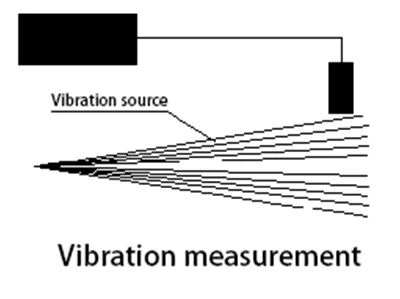
Measure radial vibration, you can see the working state of the bearing from it, you can also see the unbalance, misalignment and other mechanical failures of the rotor. It can provide the information needed for mechanical condition monitoring of the following key or basic machinery:
· Industrial turbines, steam/gas
· Compressor, air / special purpose gas, radial / axial
· Electric motor
· Generator
· Exciter
· Gearbox
· Pump
· Fan
· Blowers
· Reciprocating Machinery
Vibration measurement can also be used for continuous monitoring of general small machinery.
Differential expansion measurement:
For a turbo-generator set, when it starts and stops, due to the difference in metal materials, the difference in thermal expansion coefficient, and the difference in heat dissipation, the thermal expansion of the shaft may exceed the expansion of the shell. It may cause the rotating parts of the turbine and the stationary parts (such as the casing, nozzle, pedestal, etc.) to contact each other, resulting in damage to the machine. Therefore, the measurement of differential expansion is very important.

Rotation speed measurement:
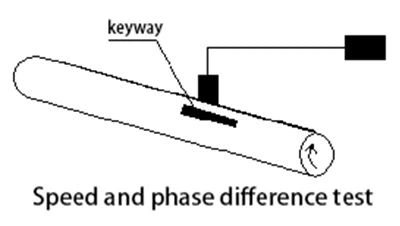
For all rotating machinery, it is necessary to monitor the rotation speed of the rotating machinery shaft. The rotation speed is an important indicator to measure the normal operation of the machine. The superiority of the eddy current sensor in measuring speed is unmatched by any other sensor. It can respond to zero speed and high speed, and its anti-interference performance is also very strong.
The eddy current sensor is usually used to measure the speed of φ 3mm, φ 4mm, φ 5mm, φ 8mm, φ 10mm probe. The frequency response of speed measurement is 0 ~ 10KHZ. The signal amplitude output by the sensor is relatively high (in the whole range of low speed and high speed) and has strong anti-interference ability. Passive magnetoelectric sensor is a power generation type sensor designed for measuring gears. It is not suitable for measuring zero speed and lower speed. Because of low frequency, small amplitude signal and poor anti-interference ability, it does not need power supply. The active magnetoelectric sensor uses +24V power supply, the output waveform is a rectangular wave, and it has the load driving capability, which is suitable for measuring the speed signal above 0.03HZ.
Installation requirements:
1.Radial vibration measurement of shaft
When the radial vibration of the shaft needs to be measured, the diameter of the shaft is required to be more than three times the diameter of the probe. Two sensor probes should be installed at each measuring point at the same time, and the two probes should be installed on the same plane on both sides of the bearing 90° ± 5° apart. Since the bearing cover is generally divided horizontally, the two probes are usually installed at 45° on each side of the vertical centerline. When measuring the radial vibration of the shaft, the installation position of the probe should be as close as possible to the bearing, otherwise the value obtained will be deviated due to the deflection of the shaft.
The maximum distance between the shaft's radial vibration probe installation position and the bearing.
Installation of the probe when measuring the radial vibration of the shaft:
Measure the bearing diameter the maximum distance
0~76mm 25mm
76~510mm 76mm
greater than 520mm 160mm
The center line of the probe should be orthogonal to the axis line, and the surface monitored by the probe (the entire circumference of the shaft 1.5 times the width of the probe diameter on both sides of the probe center line) should be free of cracks or any other discontinuous surface phenomena (such as key grooves, concavities, oil holes, etc.), and there can be no metal spraying or electroplating within this range, and the surface roughness should be between 0.4 um and 0.8 um.
2.Axial displacement measurement of shaft
When measuring the axial displacement of the shaft, the measurement surface should be an integral part of the shaft. This measurement surface is a probe ring centered on the center line of the probe and 1.5 times the width of the probe ring. The installation distance of the probe should not exceed 305mm from the thrust flange. Otherwise, the measurement result will not only include the change in axial displacement, but also the change in expansion difference, so the measured value is not the true displacement value of the shaft.
3.Key phase measurement
The key phase measurement is to set a groove or convex key on the shaft to be tested, which is called the key phase mark. When this groove or convex key is turned to the probe position, it is equivalent to a sudden change in the distance between the probe and the measured surface. The sensor will generate a pulse signal. Each time the shaft rotates, a pulse signal will be generated, the moment of generation indicates the position of the shaft in each revolution period. Therefore, by counting pulses, the rotation speed of the shaft can be measured; by comparing the pulse with the vibration signal of the shaft, the phase angle of the vibration can be determined, which can be used for shaft dynamic balance analysis and equipment failure analysis and diagnosis.
The groove or convex key should be large enough to make the peak-to-peak value of the pulse signal not less than 5V. Generally, if a φ 5 or φ 8 probe is used, the width of the groove or convex key should be greater than 7.6mm, the depth or height should be greater than 1.5mm (2.5mm or more is recommended), and the length should be greater than 0.2mm. The groove or convex key should be parallel to the center line of the shaft, and its length should be as long as possible to prevent the probe from facing the groove or convex key when the shaft moves in the axial direction. In order to avoid excessive changes in the gap between the probe and the measured surface due to axial displacement, the key phase probe should be installed in the radial direction of the shaft instead of in the axial position. The key phase probe should be installed on the drive part of the unit as much as possible, so that even if the drive part of the unit is separated from the load, the sensor will still have a key phase signal output. When the unit has different speeds, it is usually necessary to have multiple sets of key phase sensor probes to monitor it, so as to provide effective key phase signals for each part of the unit.
The key phase mark can be a groove or a convex key, and the standard requires the form of a groove. When the mark is a groove, install the probe to adjust the initial installation gap to the complete part of the shaft (installed at the linear midpoint of the sensor is appropriate), instead of adjusting the initial installation gap to the groove. When the mark is a convex key, the probe must adjust the initial installation gap to the top surface of the protrusion (installed at the linear midpoint of the sensor is appropriate), not to the other complete surface of the shaft. Otherwise, when the shaft rotates, it may cause the convex key to collide with the probe and cut the probe.

The influence of the measured object on the characteristics of the eddy current sensor:
1.The influence of the material to be measured on the sensor
The characteristics of the sensor are related to the conductivity б and magnetic permeability ξ of the measured object. When the measured object is a magnetic material (such as ordinary steel, structural steel, etc.), due to the simultaneous existence of eddy current effect and magnetic effect, the magnetic effect counteracts the eddy current effect, which weakens the eddy current effect, that is, the sensitivity of the sensor is reduced. When the measured object is a weak magnetic material (such as copper, aluminum, alloy steel, etc.), because the magnetic effect is weak, the eddy current effect is relatively strong, so the sensor sensitivity is high.
2.The influence of the surface flatness of the measured object on the sensor
Irregular surface of the measured object will bring additional errors to the actual measurement. Therefore, the surface of the measured object should be flat and smooth, and there should be no protrusions, holes, nicks, grooves and other defects. The general requirement is that the measured surface roughness for vibration measurement is between 0.4um and 0.8um; for displacement measurement, the measured surface roughness is between 0.4um and 1.6um.
3.The influence of the surface magnetic effect of the measured object on the sens
The eddy current effect is mainly concentrated on the surface of the measured object. If the residual magnetic effect is formed during the machining process, as well as uneven quenching, uneven hardness, uneven metallographic structure, and uneven crystal structure, the sensor characteristics will be affected. During vibration measurement, if the residual magnetic effect on the surface of the measured object is too large, the measurement waveform will be distorted.
4.The influence of the coating on the surface of the measured object on the sensor
The effect of the coating on the surface of the measured object on the sensor is equivalent to changing the material of the measured object. Depending on the material and thickness of the coating, the sensitivity of the sensor will slightly change.
5.The influence of the surface size of the measured object on the sensor
Because the range of the magnetic field generated by the probe coil is constant, the eddy current field formed on the surface of the object to be measured is also constant. In this way, there are certain requirements on the surface size of the object to be measured. Generally, when the surface of the object to be measured is a flat surface, the diameter of the surface to be measured should be greater than 1.5 times the diameter of the probe head with the point directly facing the center line of the probe as the center. When the measured body is a circular axis and the probe center line is orthogonal to the axis center line, the diameter of the measured shaft is generally required to be more than 3 times the diameter of the probe head, otherwise the sensitivity of the sensor will decrease. The smaller the surface of the test object, the more the sensitivity drops. Experimental tests show that when the size of the surface of the test object is the same as the diameter of the probe head, its sensitivity will drop to about 72%. The thickness of the measured object will also affect the measurement result. The depth of the eddy current field in the measured object is determined by frequency, material conductivity, and magnetic permeability. Therefore, if the measured object is too thin, the effect of eddy current will be insufficient, and the sensitivity of the sensor will decrease. Generally, magnetic materials such as steel with a thickness of more than 0.1mm and weak magnetic materials such as copper and aluminum with a thickness of more than 0.05mm are required. Then the sensitivity will not be affected by its thickness.



